

Hello, everyone!
This is Dale Quarrington from Dale’s Korean Temple Adventures, and this is my first post here on Substack. I decided to write some of my longer posts here on Substack, as they don’t quite fit on my website or in my writing at the Korea Times.
For my first post, I thought I would discuss the history of the Seokguram Grotto. In particular, I thought I would write about the founding of the grotto—when it was created, who may have created it, and why they created it.
Hope you enjoy! And if you do enjoy, please do subscribe.
What’s in a Name?
Every year, around one million visitors come to visit Seokguram Hermitage and its grotto. The grotto is among the finest pieces of Buddhist architecture and artwork in the world, making Seokguram Hermitage and its grotto famous far beyond the borders of South Korea.
However, Seokguram Hermitage and its grotto weren’t always known as “Seokguram.” Instead, and for a much longer period of time, the grotto was known as Seokbulsa Temple. During Japanese Colonial Rule (1910–1945), and while conducting preservation work on the grotto, a roof tile was discovered with the inscription “Seokbul” written on it. This roof tile dates back to Unified Silla (668–935 A.D.).
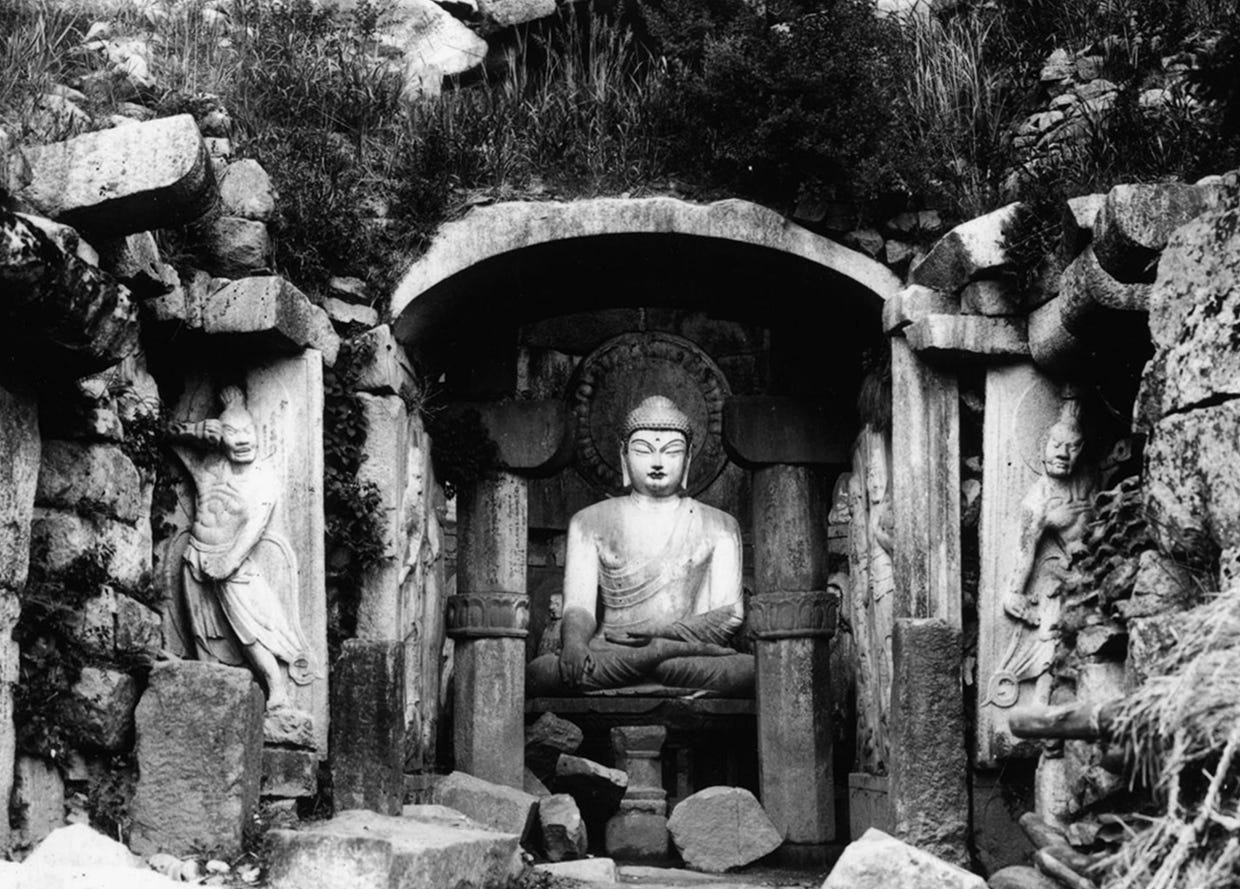
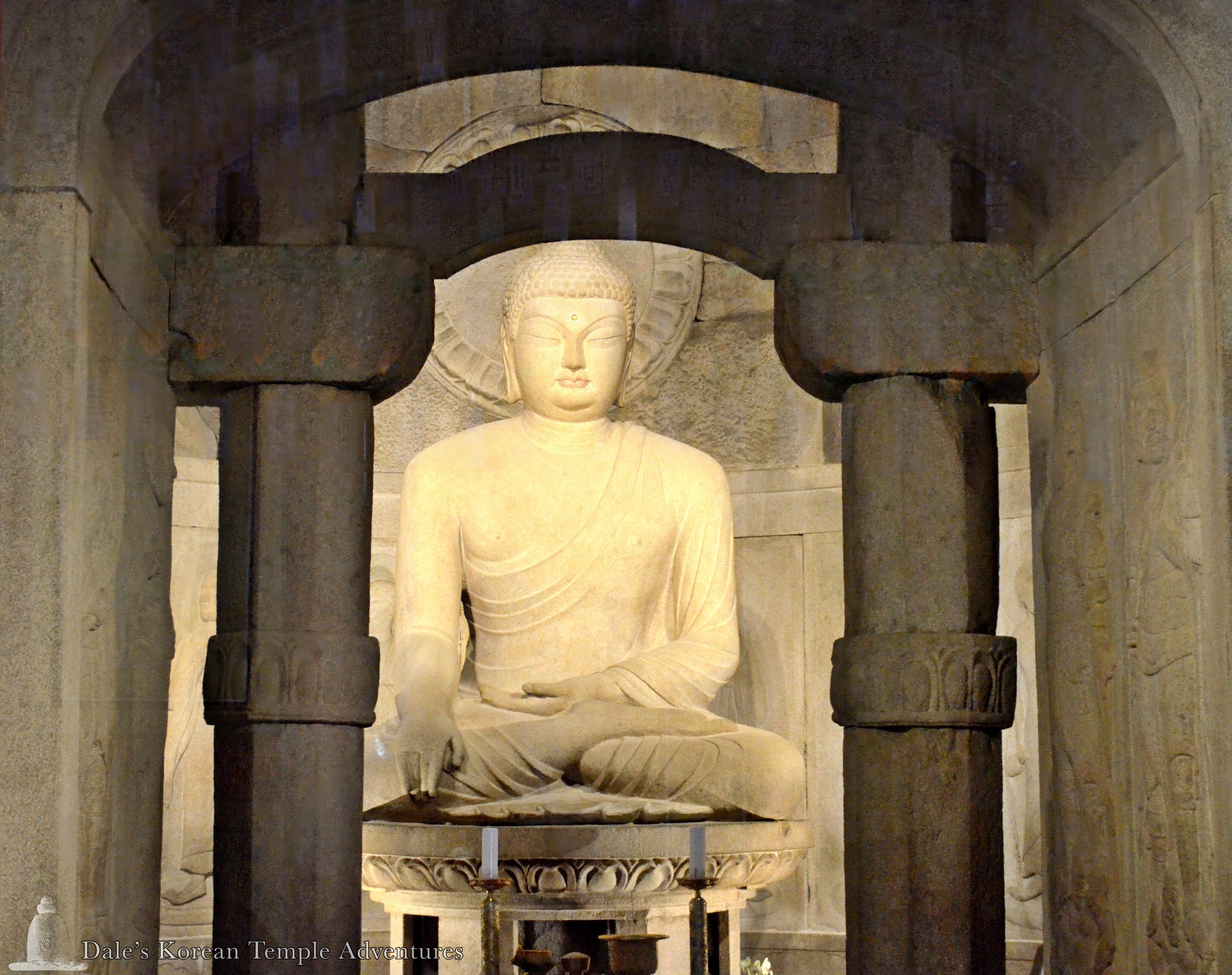
It’s believed that the main reason the temple was given this name, Seokbulsa Temple, was because of the central Buddha image inside the inner chamber. It was only during the late Joseon Dynasty (1392–1910) that Seokbulsa Temple (Seokguram Hermitage) became a subsidiary hermitage of Bulguksa Temple.
As for the name “Seokguram,” it first appears in the Diary of Life in the Mountains by Jeong Si-han (1625–1707). According to Kang Huijeong’s paper “The Birth of a Masterpiece: The Myth of Seokguram in the 20th Century,” Kang states how the scholar Jeong traveled from Wonju to see the grotto. Jeong had decided to make the long journey as part of a tour of the Eight Provinces’ famous scenic sites. Included in this list was Seokbulsa Temple (Seokguram). After climbing more than ten ri (approximately 4 km) of steep mountain trail from Bulguksa Temple, he finally arrived at the stone grotto. As Kang states about Jeong,
“The effort of sweating profusely to climb the mountain had truly paid off. Though made by human hands, the structure [the Seokguram Grotto] was so wondrous and mysterious that it seemed as if it had been shaped by the heavens.”
Following this, and during Japanese Colonial Rule (1910–1945), the site became known as Seokguram Hermitage. This first happened in 1909, when Sekino Tadashi (1868-1935) gave a lecture entitled “On the Transition of Korean Art” at the Ministry of Finance. This lecture was later compiled into a text entitled Han Koyo, where the name “Seokguram” is briefly mentioned. This name seemingly stuck, as other Japanese scholars used the name as well, like Yanagi Muneyoshi (1889-1961).
However, in 1915, the Korean linguist An Hwak published an article titled “The Art of Joseon” in the magazine Hakjigwang. This article is considered the earliest known Korean art theory written by a Korean. In this article, An references “Gyeongju Bulguksa, Seokbulam,” which clearly indicates that there was still some confusion as to what to call Seokguram Hermitage/Seokbulsa Temple.
By the 1920s, however, “Seokguram” seems to have become the norm. On June 3, 1923, The Dong-A Ilbo ran a new serialized column entitled “Wonders of the World.” In this series, the first installment was about the Seokguram Grotto:
“The Buddha statues of Seokguram Grotto in Gyeongju are said to be the oldest and greatest works of art in the East…”
This was subsequently followed by tours led by The Chosun Ilbo to Gyeongju. In one of their travelogue, it was titled “The Buddha Statue of Seokguram is the Guardian of National Defense.”
Lastly, by October 1930, with the popularization of travel to Gyeongju by both Japanese and Koreans alike, schools would also visit the grotto. In fact, and once again according to Kang Huijeong’s paper “The Birth of a Masterpiece: The Myth of Seokguram in the 20th Century,” “…Jeong Bong-deuk, a fourth-year student at Ewha Girls’ High School, published a serialized travel essay titled ‘Travelogue of Gyeongju’ in The Chosun Ilbo. She wrote of ‘visiting Dabo-tap Pagoda, the finest of all Silla pagodas,’ ‘taking commemorative photos to honor the imperishable art made by our ancestors,’ and then climbing to Seokguram after passing through Bulguksa Temple. Her description of Seokguram was no different from that of Japanese sources—it was exactly what she had learned from them [the Japanese].”
Both through indoctrination (textbooks and education) and social norms during Japanese Colonial Rule, the name “Seokguram” seems to have stuck—both among the Japanese and Koreans. And it has remained in use to the present day.
The Founding of Seokguram Hermitage (Seokbulsa Temple)
One of the biggest controversies is when construction on the Seokguram Grotto started and ended. Based upon the Samguk Yusa, or Memorabilia of the Three Kingdoms in English, most scholars agree that Seokguram Hermitage began construction in 751 A.D., alongside Bulguksa Temple. As for when Seokguram Hermitage was completed, there’s more controversy. According to the Samguk Yusa, Kim Daeseong died 24 years later, in 774 A.D., after which the Silla state completed the project. However, it doesn’t give a specific date of completion. According to Seo Jimin’s paper titled “The Background of the Construction of Seokguram and a Hwaeom Doctrinal Interpretation of the Iconography of the Main Buddha Statue,”
“…some argue that Seokguram was completed during Kim’s lifetime, while Bulguksa was finished under King Hyegong (r. 758–780 A.D.).”
As for who originally constructed Seokguram Hermitage, we can look to the Samguk Yusa once more for answers. According to the Samguk Yusa:
“Daeseong [Kim Daeseong, 700–774 A.D.] liked to hunt as he was growing up and was once lodging in a little village at the base of Mt. Tohamsan after catching a bear. He dreamed that the bear changed into a ghost who threatened that in his next life he would catch and eat Daeseong if Daeseong killed him. Daeseong then asked for forgiveness in the dream, and the ghost-bear asked him to build a temple on his behalf. Daeseong vowed to do just that, and when he woke up, he discovered that he had been perspiring profusely. Daeseong then gave up hunting and built Jangsusa Temple [Long Life Temple, in English] on the site where he caught the bear. His mind and heart were by now completely turned to Buddhism. He then built Bulguksa Temple for his parents in his present life [Kim Munyang and his wife] and Seokbulsa Temple for his parents from his previous life [Gyeongjo]. Two Buddhist monks, Sillim and Pyohun, were made to reside there. All this is recorded in the Old Records. Meanwhile, the official record of the temple gives the following information: ‘During the reign of King Gyeongdeok [r. 742–765 A.D.], Daeseong, the chief minister, commenced the construction of Bulguksa Temple in the tenth year of Tianbao [751]. It had not yet been completed, however, when Kim Daeseong passed away on the second day of the twelfth month of Jiayin, the ninth year of the Dali [774]. The Silla government then stepped in and completed it.”
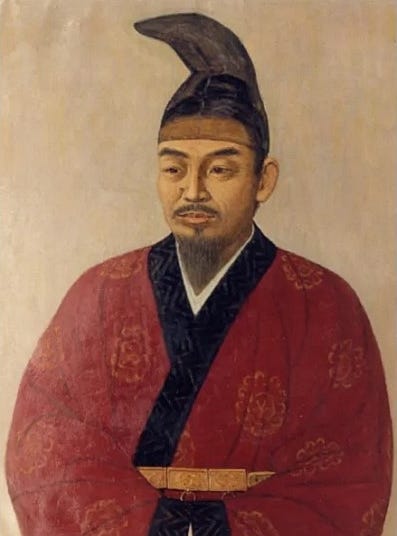
Who Was Kim Daeseong?
So, who was Kim Daeseong? Well, according to Kang Woobang, in his academic paper titled “Bulguksa Temple and Seokbulsa Temple,” Kim Daeseong and his father Kim Munyang are identified as Kim Daejeong and Kim Munryang.
Kim Munryang served as the chief minister (jungsi) from 706–711 A.D. under King Seongdeok, while Kim Daejeong served as chief minister to King Gyeongdeok from 745–750 A.D. Additionally, it’s been argued by some, like Hwang Suyeong, that Kim Daeseong was, in fact, a member of the Kim royal family and that Seokguram Hermitage was built as a royal temple for the Kim clan of Gyeongju.
With that being said, after conceptualizing both Bulguksa Temple and Seokguram Hermitage (Seokbulsa Temple), Kim Daejeong (Daeseong) is said to have started the construction of both after his retirement as chief minister.
However, as a chief minister, would Kim Daejeong (Daeseong) have had both the political clout and financial backing to create two temples in Gyeongju? Also, why would he build both temples on Mt. Tohamsan in eastern Gyeongju?
According to Choi Wansu, in his published article titled “Why Has Bulguksa Temple Turned into Kim Daeseong’s Private Temple?” Choi proposes that both temples were originally patronized by King Gyeongdeok, not by Kim Daeseong as described in the Samguk Yusa, where he is named as the single patron of the temples.
Choi argues that King Gyeongdeok built the two temples to commemorate his deceased father, King Seongdeok (r. 701–737 A.D.). He goes on to propose that King Wonseong (r. 785–798 A.D.) later asserted that Kim Daeseong was the patron in order to conceal King Gyeongdeok’s achievements. The reason for this concealment lies in the relationship between Kings Wonseong and Gyeongdeok. King Wonseong usurped the throne; and therefore, ended the previous royal lineage of Silla that started with King Taejong Muyeol (r. 654–661 A.D.).
This lineage continued until the reign of King Hyegong (r. 765–780 A.D.), who was the son of King Gyeongdeok. However, King Hyegong was assassinated. The subsequent Silla rulers afterwards all came from the line of King Wonseong’s descent.
So why is this important? Well, according to Choi, this was a way to erase the memories of the previous lineage. The ancestral shrines of Kings Gyeongdeok and Seongdeok were destroyed. They were replaced by shrines for King Wonseong’s father and grandfather. In the same vein, a new narrative in the form of Kim Daeseong in the Samguk Yusa was put forth to erase one of King Gyeongdeok’s greatest achievements—Bulguksa Temple and Seokguram Grotto.
What Choi’s argument revolves around is the reliability of the Samguk Yusa. Choi isn’t the first to question the reliability of this historic text, written by the monk Iryeon (1206–1289) around 1281. The Samguk Yusa is filled with history, myths, and legends surrounding the history of Korea, as well as stories related to Korean Buddhism. The only problem with this is the blurring of fact and fiction through its inclusion of myths and legends.
Because of this, some historians have decided to look to the Samguk Sagi, or History of the Three Kingdoms in English, by Kim Pusik (1075–1151), which was completed in 1145, instead. The only problem with this is that neither Bulguksa Temple nor Seokguram Hermitage (Seokbulsa Temple) are mentioned. Not only that, but Kim Daeseong doesn’t appear, either.
So, with a lack of information, we stick to what we do actually have. And in this case, that’s what I quoted earlier. Specifically:
“It [Bulguksa Temple] had not yet been completed when Kim Daeseong passed away on the second day of the twelfth month of Jiayin, the ninth year of the Dali reign [774]. The Silla government then stepped in and completed it [Bulguksa Temple].”
According to Choi Sun-ah, in “Filial Piety and Politics: Rethinking Patronage and Filial Piety at Seokguram and Bulguksa in Gyeongju, Korea,” Choi states:
“…some of those who believe that Bulguksa Temple and Seokguram Hermitage must have been national temples think that filial piety could not be the only reason for the construction of such grandiose monuments, which is stated as the reason for the construction of Bulguksa Temple in the Samguk Yusa.”
Furthermore, historians who don’t fully trust the Samguk Yusa highlight the inseparability of state and religion. Typically, Buddhist temples that were constructed earlier on, after the acceptance of Buddhism as a state religion—like Sacheonwangsa Temple and Gameunsa Temple—were state-defending temples. They were built to protect the nation from invasion by the Wa (Japanese), as well as to pray for the well-being of the royal family.
Choi directs us to another scholar, Seong Nakju, who makes two very valid points to counter the narrative that Kim Daeseong was the sole patron of Bulguksa Temple and Seokguram Hermitage. Instead, Seong proposes that someone like King Gyeongdeok, through royal patronage, may have constructed the two amazing temples.
The first argument that Seong makes is to counter the idea that the two temples were “national or royal temples.” The way Seong does this is by directing us to the list of major temples (seongjeon saweon) of Unified Silla (668–935 A.D.) that were directly governed by the Silla state. Several of these lists appear in the Samguk Sagi, but both Bulguksa Temple and Seokguram Hermitage are not mentioned.
The second argument that Seong makes to support the idea of Kim Daeseong as the sole patron of the two grand temples is that the Wa (Japanese) were no longer a threat during the time that Bulguksa Temple and Seokguram Hermitage were being built. In fact, there had been “no report of any invasion by them [Wa] since the early seventh century.” Knowing this negates the notion that Seokguram Hermitage and Bulguksa Temple were built to protect Silla from Japan.
Further bolstering the claim that Kim Daeseong was the sole patron of Bulguksa Temple and Seokguram Hermitage is an early 11th century manuscript fragment found inside Seokga-tap Pagoda at Bulguksa Temple. The manuscript fragment was discovered during conservation work on the historic pagoda. In part of the text from this fragment, it reveals:
“This pagoda [Seokga-tap Pagoda] was founded by Kakgan Daeseong, the chief minister during the reign of King Gyeongdeok. It was begun in the first year of the Tianbao era (742) and finished during King Hyegong’s reign.”
What’s interesting about this quote is that it solely mentions Kim Daeseong. Not only that, but this record predates the Samguk Yusa. While the quote doesn’t contain any background information, it does quite a bit to bolster Kim Daeseong’s claim as the patron of the two temples.
The reason for the construction of both Bulguksa Temple and Seokguram Hermitage lies in the Silla belief at the time that Buddhist merit-making combined with filial piety (praying for the well-being of one’s deceased parents) would gain merit through acts like temple construction. This merit could, ultimately, be transferred to Kim Daeseong’s dead parents.
But to throw a bit of a wrench into things, there is an argument made by some scholars, like Seo Jimin, that the amount of resources and labor needed to complete Seokguram would have been enormous. Also, based upon the differing styles of statues and reliefs inside the grotto—including the central Buddha, the Four Heavenly Kings, and the Eight Legion in the antechamber—they differ in age by more than 50 years. So perhaps Seokguram took 50 years to complete, or it was repaired later by the state of Silla. Either way, it’s something to consider as we look more closely at Kim Daeseong.
Other Sites for Filial Piety in Gyeongju
So, if Kim Daeseong decided to build both temples out of a sense of filial piety, what was the context for this practice during the Silla Dynasty (57 B.C.–935 A.D.)? Are there other examples?
One example from Unified Silla is the construction of Gameunsa Temple, which means “Repaying Gratitude Temple” in English. Originally, the temple was constructed to defend Silla from the piracy of the Japanese. According to the Samguk Yusa:
“…King Munmu [r. 661–681 A.D.] wanted to quell the Japanese military. Therefore, he began to construct a temple. He passed away before completing [the temple], and became a dragon in the sea. His son [King] Sinmun [r. 681–692 A.D.] ascended to the throne and completed [the construction of the temple] in the second year of the Kaiyao era (682).”
Very obviously, Gameunsa Temple was first commissioned by King Munmu to defend Silla. However, the purpose and meaning of the temple changed when King Sinmun completed it. The temple was completed out of gratitude to his deceased father for his concern for the peace of Silla.
Another example from Silla concerning a Buddhist temple and filial piety is Hwangboksa Temple, or “Imperial Fortune Temple” in English, which is also located in Gyeongju. Specifically, a reliquary set was found inside the three-story pagoda at Hwangboksa Temple. The inscription on the lid of the reliquary states that Queen Sinmok, who was the wife of King Sinmun, and her son, King Hyoso (r. 692–702 A.D.), built the pagoda in 692 A.D. for the benefit of the late king’s afterlife.
When both Queen Sinmok and King Hyoso died, King Seongdeok enshrined a statue of Amita-bul (The Buddha of the Western Paradise) in the reliquary, alongside a sutra, inside the pagoda in 706 A.D. So, the royal family of Unified Silla—from King Sinmun to King Seongdeok—commissioned Buddhist works to help commemorate their parents. (Sound familiar?)
Silla Society, Funeral Rites, and Burial
It’s also around this time—a couple hundred years before the construction of Bulguksa Temple and Seokguram Hermitage—that we see a seismic change in Silla governance. In the early sixth century, we see advancements in agriculture, and we also see a movement toward the Sinicization of political institutions.
It’s also at this time that the nation is formally called “Silla,” and the Chinese term “wang” (king) is adopted, replacing the native title of maripkan in the political sphere. In 527 A.D., Buddhism becomes the state religion. This helps centralize power around the Silla royal family, shifting it away from regional factional beliefs centered on shamanism.
Another interesting change around this time is the shift in funeral ceremonies and burial practices. Previously, especially for royals, bodies were buried inside wooden chambers covered by stone mounds. These tombs can still be found in central Gyeongju, and they date back to the mid-fourth to sixth centuries.
However, this practice would change at the start of the early to mid-sixth century due to the introduction of Buddhism to Silla. Instead of burial, people were now being cremated. Tombs were also now being made on low hills and at the foot of large mountains surrounding Gyeongju, including Mt. Namsan, Mt. Seondosan, and Mt. Tohamsan.
A large number of Silla urns are now housed in museum collections. Many of these urns were accidentally discovered or looted long ago, rather than formally excavated. While the original locations of these urns are unknown, historians believe they were originally buried near the mountains of Gyeongju. For example, King Beopheung was buried in the foothills of Mt. Seondosan, and King Gyeongdeok was buried near Mt. Namsan.
Mt. Tohamsan in Eastern Gyeongju
As for Mt. Tohamsan, it was regarded as one of the major mountains during Unified Silla. It was considered the primary sacred mountain in the east of Gyeongju. Mt. Tohamsan was also associated with the cult of Seok Talhae (r. 57–80 A.D.), the fourth king of Silla. According to tradition, Seok Talhae is said to have climbed to the top of Mt. Tohamsan when he first entered Silla, and his statue was later enshrined on the mountain. Rites for Seok Talhae were conducted annually.
Because of this, scholars tend to view Mt. Tohamsan as a location associated with state protection rituals. This symbolism was further reinforced by the location of King Munmu’s tomb in the East Sea, just east of Mt. Tohamsan, which served as a symbolic guardian protecting Silla from Japan.
However, during the late seventh century, the foothills of Mt. Tohamsan started to change. The tomb of King Sinmun was constructed on the left foothills of Mt. Tohamsan. This was followed by the tombs of Kings Hyoso and Seongdeok. The spread of royal tombs around Mt. Tohamsan points to a reshaping of the mountain’s role—from a place of state protection to a site for royal tombs and filial piety rites conducted by descendants.
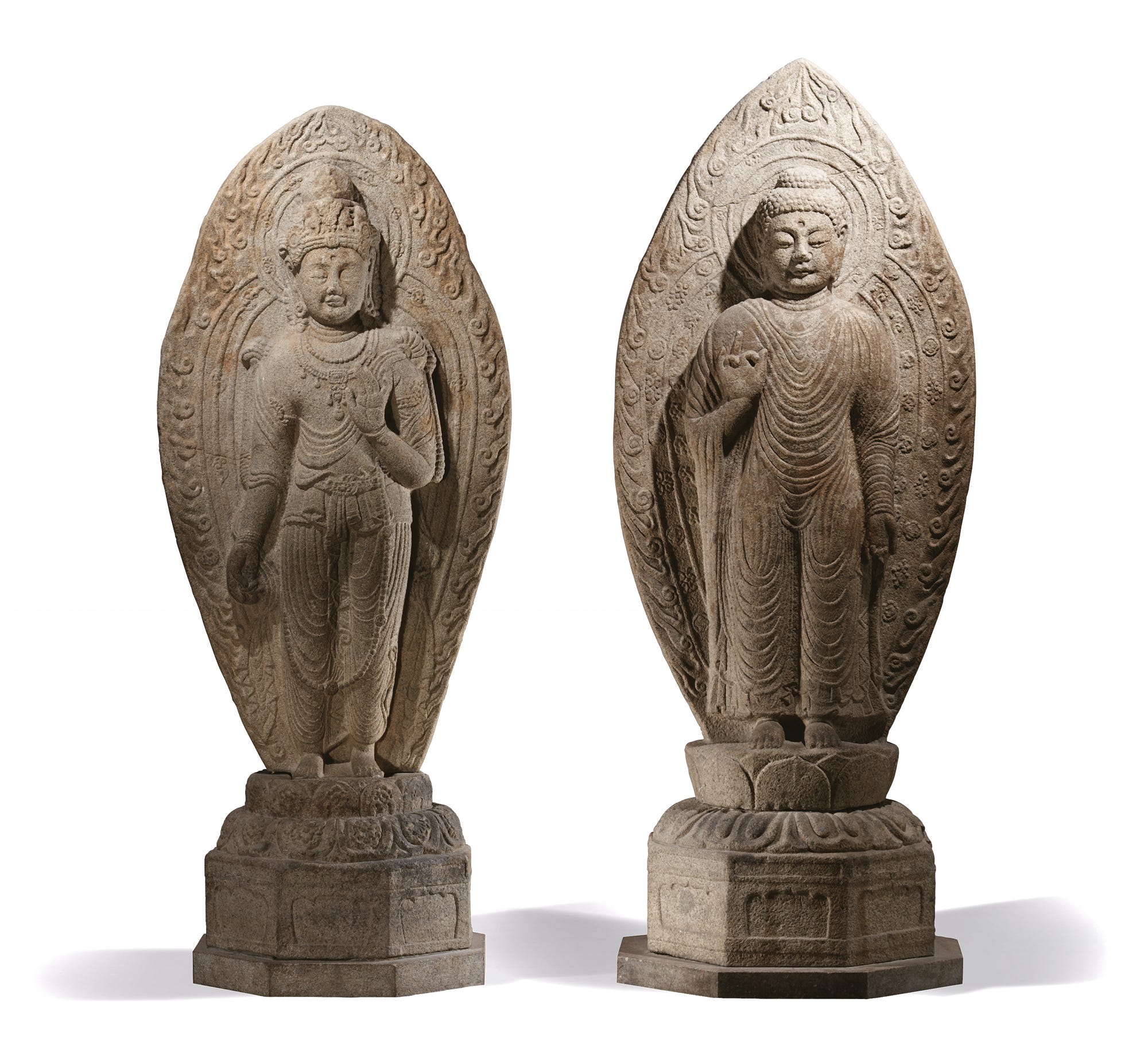
A good example of this filial piety shift specifically taking place on Mt. Tohamsan can be found at Gamsansa Temple, or “Gam Mountain Temple” in English. Two stone artifacts point to this religious and social transformation:
The Stone Standing Maitreya Bodhisattva of Gamsansa Temple
The Stone Standing Amitabha Buddha of Gamsansa Temple
Both are now National Treasures and are located in the National Museum of Korea in Seoul.
While not much of the original Gamsansa Temple still stands, the temple site remains in the foothills of Mt. Tohamsan. The two stone statues were first commissioned in 719 A.D. by a retired official named Kim Chiseong (also known as Kim Chijeon, 652–?) for his family members, including his deceased parents.
Kim was a middle-rank aristocrat, serving in the sixth of the seventeen official ranks of Silla. He eventually rose as high as deputy minister. After retiring, Kim founded a temple that became Gamsansa Temple on an estate he donated.
Based on the inscriptions on the statues:
The Maitreya Bodhisattva (Mireuk-bosal) statue was dedicated to his mother.
The Amitabha Buddha (Amita-bul) statue was dedicated to his father.
So if Kim Chiseong could build a temple and commission two stone statues for his parents, the higher ranking Kim Daeseong probably had an even greater chance of creating both Bulguksa Temple and the Seokguram Grotto.
Conclusion
Based on the royal tombs of the 8th century, the cinerary urns, and the stone statues created at Gamsansa Temple, Mt. Tohamsan appears to have transformed into a primary location for royal and aristocratic burial and commemoration.
It’s in this atmosphere and time that Kim Daeseong began to build Bulguksa Temple and Seokguram Hermitage (Seokbulsa Temple), either starting in 742 A.D. or 751 A.D., depending on the source. Either way, construction appears to have commenced in the middle of the 8th century, when Mt. Tohamsan had also undergone a spiritual and social transformation in Silla.
It’s completely plausible—based on his rank, finances, and the mountain’s significance—that Kim Daeseong was the sole patron of Bulguksa Temple and Seokguram Hermitage, as stated in the Samguk Yusa. And it’s probably largely thanks to Kim Daeseong that we now get to enjoy the Seokguram Grotto.